Why Inside

HR systems start from employee records. Inside starts from the shift.

Most HR and payroll systems are built around employees, positions and pay periods. Inside is built around the work: the demand that creates a shift, the person or labour source that fills it, the time actually worked and the pay or billing that follows. That is what keeps a changing plan workable and pay correct.

Two ways to run a workforce

Record-centred (typical HR system)

  1. Starts with the employee file.
  2. Rosters live in a spreadsheet or a separate tool.
  3. Casuals and agency staff sit outside the system.
  4. Attendance is reconciled at cut-off.
  5. Payroll re-keys hours and claims.

Shift-centred (Inside)

  1. Starts with the shift.
  2. Demand sets the roles needed.
  3. Permanent, casual and agency staff fill the same schedule.
  4. Clock-ins are matched to the plan.
  5. Confirmed time becomes the pay run or agency invoice.
Left: roster, attendance, timesheet, payroll and agency billing live in separate tools joined by manual re-keying. Right: the same five stages run on one connected shift record.

What's different

CapabilityWhat it means for you
Base manning and demand driversEach outlet knows the minimum cover by role, and busy periods can be sized from covers, room nights or events.
Smart FillDraft rosters respect role eligibility, leave, hour limits and rest rules. Managers still publish.
Cross-outlet borrowingTrained staff can work a shift at a linked outlet without a second profile.
Casuals Hub and casual appCasual requests, offers, day passes and clocking in one flow.
Agency PortalAgencies receive approved requests, assign workers and see confirmed hours.
Auto-Match timesheetsActual time is compared to the plan, and only exceptions need a manager.
Employment-type rulesContracted hours, overtime and rest are set once and used by the roster, timesheet and pay run.
Singapore payrollPay runs from confirmed timesheets, with CPF, SDL and SHG.
One app for staff and managersSchedules, clocking, requests, claims and payslips on the phone; approvals for managers.

Coexist first

You don't have to replace everything on day one.

Inside can run alongside your HR system or payroll provider. Export Manager produces timesheet and roster files in the formats your other systems need. Many teams start with scheduling and attendance in one department, then add casuals, agencies and payroll.

Integrations

Built with operators

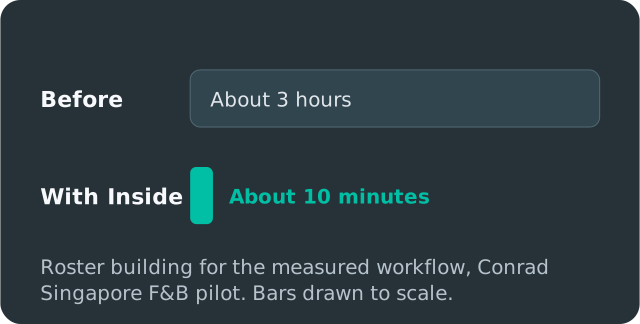
Inside was built in Singapore with hotel and F&B teams, starting from how rosters, call-outs and pay actually work on the floor. In the Conrad Singapore F&B pilot, weekly roster building for the measured workflow went from about 3 hours to about 10 minutes.

Read the pilot case study

Proportional bars: about 3 hours before Inside and about 10 minutes with Inside, for weekly roster building in the measured workflow, Conrad Singapore F&B pilot.

Frequently asked questions

Do we need to replace our HR system?

No. Inside can work alongside it. Employee data can be imported, and timesheets or rosters can be exported to the systems you keep.

Can Inside replace our current time attendance system?

Inside includes clocking in the Inside app, timesheet matching and approval. Many teams use it to replace separate attendance tools, but you can also export Inside timesheets to an existing system during a transition.

Is Inside only for hospitality?

Hospitality is where Inside was built and proven. The same shift-to-pay model works for retail, facilities, events, childcare and care teams that run rosters.

How is Inside different from a rostering app?

A rostering app stops at the published schedule. Inside carries the shift through cover, attendance, timesheets and pay, including casual and agency staff.

See how Inside fits the way your operation runs.

Tell us about your outlets, workforce mix and current tools. We'll show you the workflows that matter to your team.